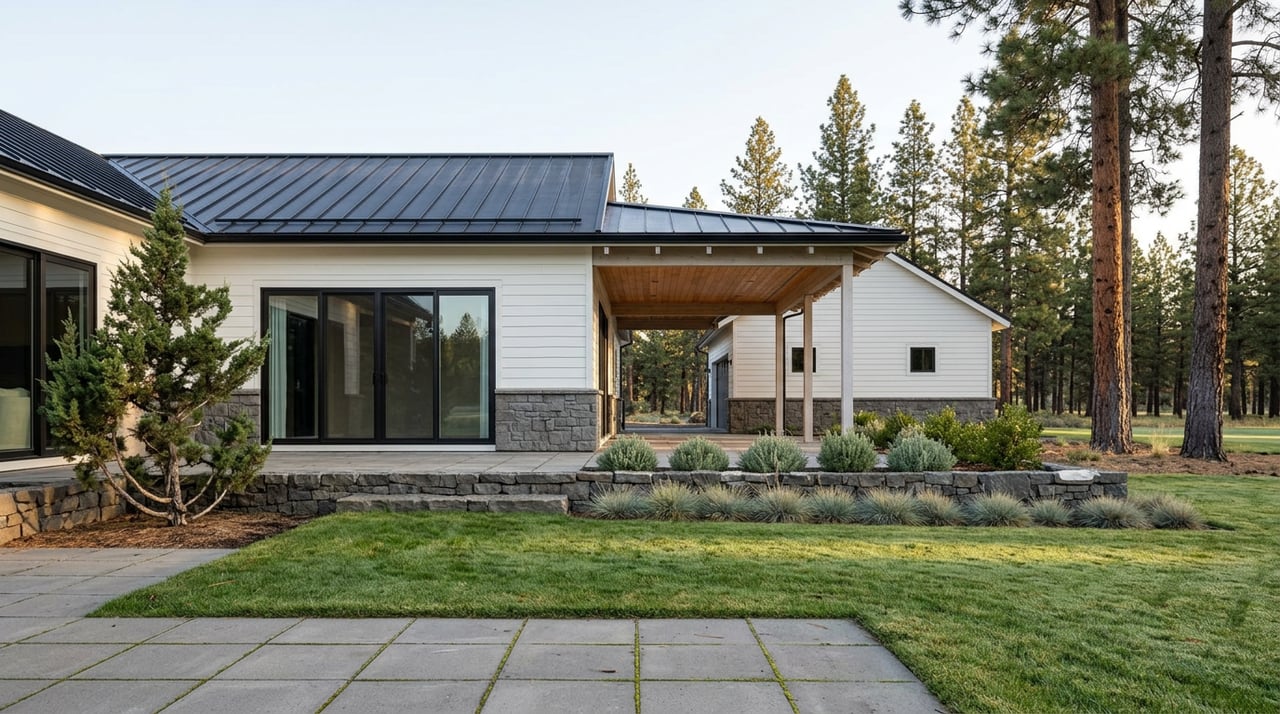
A buyer touring two nearly identical resort homes this fall, one inside Bend's city limits and one in Sunriver, will hear the same line from almost everyone they talk to: Bend restricts short-term rentals, the resorts don't. It's the kind of comparison that gets repeated so often it starts to sound like settled fact. It isn't. The regulatory gap between the two is real, but it's neither as simple nor as permanent as the shorthand suggests, and the number that actually shapes a resort rental's economics rarely comes up in that conversation at all.
If you're weighing a vacation-rental purchase in Deschutes County's resort communities, both of those gaps are worth understanding before you make an offer.
The Rule Everyone Quotes, and the Part They Leave Out
Inside the City of Bend, operating a short-term rental means securing both a Land Use Permit and a Short-Term Rental Operating License, and the city checks a map before approving either one. No new permit can be issued within 250 feet of an existing one, a separation rule adopted specifically to keep the density of vacation rentals from concentrating inside residential neighborhoods. Most active permits in Bend today trace back to applications filed before April 15, 2015, when the city's current rules took effect, with a handful of exceptions carved out for specific developments like Mt. Bachelor Village Resort.
Step outside the city limits into Sunriver, Black Butte Ranch, or Eagle Crest, and that entire framework disappears. There's no land-use permit to apply for and no operating license to renew. The only thing a county resident needs to legally rent a home for 30 days or less is a Deschutes County Certificate of Authority, a tax registration that authorizes the owner to collect the county's 8 percent transient room tax and Oregon's 1.5 percent state lodging tax. That's the version of the story most buyers hear, and it's accurate as far as it goes.
What it leaves out is that this gap has been the subject of active debate at the county level for more than two years, and that the debate has never fully closed.
What Bend's Permit System Actually Buys You
Bend's rules read as more restrictive, and they are, but restriction has a way of creating its own kind of value. Because new permits are so hard to obtain and the 250-foot rule caps how many can exist in a given area, an existing, transferable land-use permit tends to carry a real premium when a Bend property with STR rights sells. The permit itself is not automatically transferable. A new owner has to file a fresh application, which triggers a notification to surrounding property owners and comes with no guarantee of approval. Buyers who understand this walk into a Bend STR purchase already knowing the rules are fixed, scarce, and priced into the deal.
The Loophole That Isn't Guaranteed to Last
The unincorporated county's lighter touch is not an oversight. It's a policy choice the Deschutes County Board of Commissioners has been actively reconsidering since January 2024, when staff were first directed to begin building a business-license program aimed specifically at short-term rentals outside city limits. The proposal under discussion would have gone well beyond tax collection, adding elements like fire-life-safety verification, formal occupancy limits, wastewater system review, and a requirement that owners provide a 24/7 local contact for neighbors to reach in the event of a complaint. In their 2024 review, county staff estimated the program would cost somewhere between $500,000 and $1 million just to stand up.
The debate has not resolved cleanly in either direction. Commissioner Phil Chang has pushed for baseline standards, arguing the goal isn't to restrict business but to make sure short-term rental operators are being good neighbors. Commissioner Tony DeBone has questioned whether the underlying problem, mostly framed around neighbor-to-neighbor noise and nuisance complaints, is widespread enough to justify a countywide program at all. More than two years later, the county still has not adopted a business-license requirement for these resort communities, and industry guidance published as recently as this year continues to advise buyers to confirm current status before closing rather than assume the status quo will hold.
That back-and-forth matters because it means the regulatory environment that makes a Sunriver purchase look easier than a Bend one is not locked in. James Lewis, general manager of the Sunriver Owners Association, addressed this directly back when the county's review began, noting that Sunriver has a long-standing pattern of short-term rental ownership, with an estimated 35 to 40 percent of the community's roughly 4,200 properties operating as vacation rentals at that time, and that he supports a public process to evaluate changes as long as the county is clear about what problem it's actually trying to solve.
For a buyer running numbers on a 20 or 30-year hold, that's not background noise. It's a live variable.
The Real Math Is in the Bedroom Count, Not the Zoning Code
Here's the part that catches most buyers off guard, and it has nothing to do with the county at all. Sunriver's HOA, the Sunriver Owners Association, layers its own cost structure on top of whatever the county decides, and that structure is tied directly to how many bedrooms are on file with the Deschutes County Assessor's office.
Every owner in Sunriver pays a monthly SROA maintenance assessment, listed at roughly $172.94 per month for 2026, sometimes bundled with additional SHARC or bulk fiber internet charges depending on the property. That fee applies whether or not you ever rent the home.
Rental owners who want their guests to have access to SHARC, the community's indoor and outdoor aquatics center, along with tennis, pickleball, disc golf, and the boat launch, typically enroll in the Recreation Plus Program, or RPP. The number of recreation cards a property receives is set by the county's occupancy formula of two people per bedroom plus two, calculated off the bedroom count in the assessor's records. A two-bedroom home receives six cards. The RPP fee itself scales with that same bedroom count, and the 2026 schedule runs from roughly $1,380 a year for a one-bedroom home up to about $6,210 for an eight-bedroom property.
| Recorded Bedrooms | Approx. Recreation Cards (2/bed + 2) | 2026 RPP Fee (approx.) |
|---|---|---|
| 1 | 4 | $1,380 |
| 2 | 6 | (scales between tiers) |
| 4 | 10 | (scales between tiers) |
| 8 | 18 | $6,210 |
That range means two homes that look nearly identical from the street, similar square footage, similar finishes, similar list price, can carry very different fixed annual costs simply because one has a bedroom the other doesn't, or because one owner finished a bonus room that was never recorded as a bedroom with the county.
Reading Two Listings Side by Side
Put these two threads together and the comparison most buyers start with gets more complicated in a useful way. Bend's system is restrictive but stable. You know the rules going in, and if the property already carries a transferable permit, that scarcity is reflected in the price. The county's resort communities offer more flexibility today, but that flexibility has been formally on the table for revision since 2024, and the HOA math that runs underneath it, the bedroom-indexed RPP fee and the flat SROA assessment, applies regardless of what the county decides next.
Before writing an offer on a resort-area rental property, it's worth pulling the recorded bedroom count from the county assessor, checking the current RPP fee tier that count would trigger, and asking directly whether the seller is aware of any pending changes to SROA's governing documents or the county's business-license discussions. None of that shows up in a standard listing sheet, and all of it changes the real annual cost of ownership.
A Couple of Questions Buyers Ask Us Directly
Does the RPP fee apply if I don't plan to rent the home? No. The Recreation Plus Program is specifically for owners who rent their property and want guests to have SHARC and amenity access. The separate SROA monthly maintenance assessment applies to every owner regardless of rental use.
If the county adopts a business-license program, would it apply retroactively to homes already operating as rentals? That detail hasn't been settled. It's exactly the kind of open question worth asking a local agent or attorney about before you close, since the shape of any future program, and whether existing rentals would be grandfathered, has been part of what commissioners have been debating rather than something already decided.
Buying a vacation-rental property in Central Oregon's resort communities means underwriting two systems at once: the county's tax and permit framework, and the HOA's own fee structure. We walk buyers through both before they write an offer, using the actual assessor records and current SROA fee schedules rather than assumptions carried over from a Bend listing. If you're comparing resort communities and want a clear-eyed read on what a specific property will actually cost to carry, Team Fitch can help you run the numbers before you fall in love with the view.